Regional Cross-Border Consultation Workshop on Solutions for Disaster Displacement
Communities living along the borderlands of the Intergovernmental Authority on Development (IGAD) region face some of the most complex and interlinked challenges in the Horn of Africa. Areas such as Moyale, Karamoja, Mandera, Mbale, Nimule, and Ali Addeh are increasingly affected by climate shocks, protracted drought, floods, landslides, resource-based conflicts, and governance constraints. These pressures have intensified displacement patterns, straining already vulnerable communities and local institutions.
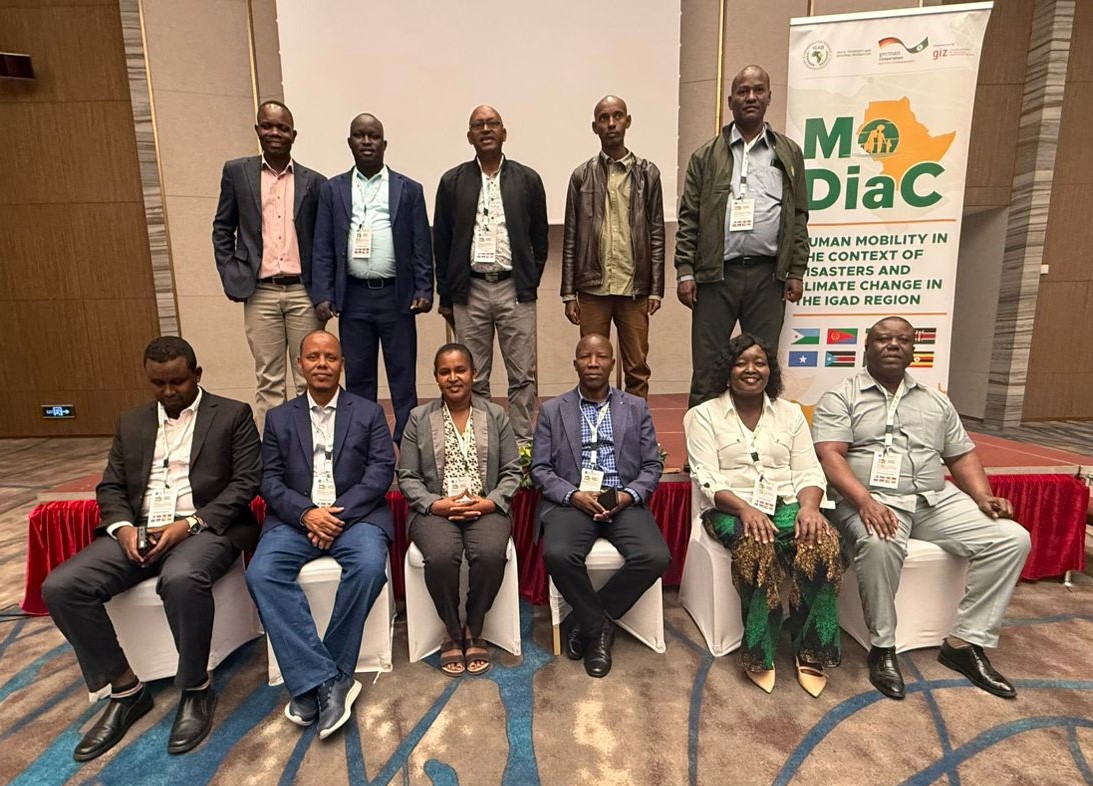
To respond to these urgent challenges, IGAD, in partnership with GIZ and supported by German Cooperation (BMZ), convened a Regional Cross-Border Consultation Workshop on Solutions for Disaster Displacement from February 10–12, 2026 in Addis Ababa, Ethiopia. The workshop marked a critical milestone in advancing the Human Mobility in the Context of Disasters and Climate Change in the IGAD Region (MoDiaC) project.
This high-level consultation brought together mobility, disaster risk management (DRM), and climate focal points, border officials, community leaders, and technical experts to co-design practical, locally grounded solutions for climate- and disaster-induced displacement.
Background: A Region Under Pressure
Between 2020 and 2023, the IGAD region endured the worst drought in four decades, devastating livelihoods across Somalia, Ethiopia, and Kenya. In 2022 alone, climate-related disasters displaced over 3.5 million people across IGAD Member States. Today, drought conditions persist in parts of Somalia, Kenya, and Ethiopia, with the risk of further escalation.
Pastoralist communities in border areas have suffered immense livestock losses, forcing migration in search of water and pasture. Women and youth have borne disproportionate impacts, facing increased protection risks, loss of income, and reduced access to essential services. At the same time, resource scarcity has intensified communal tensions, triggering conflict-related displacement in fragile border zones.
Despite strong regional policy frameworks—such as the IGAD Free Movement Protocol (2020), the IGAD Disaster Risk Management Strategy (2020–2030), and the Kampala Declaration (2022)—operationalization at local and cross-border levels remains constrained by limited capacity, fragmented data systems, and insufficient coordination mechanisms.
The MoDiaC project was launched to help bridge these gaps by strengthening institutional capacity, enhancing displacement data systems, and promoting community-based, climate-resilient solutions.
The MoDiaC Project: Linking Policy, Data, and Local Action
The MoDiaC project is structured around three core outputs:
Policy and Institutional Strengthening
Data and Modelling for Disaster Displacement (Early Warning & Trend Analysis)
Local-Level Climate-Resilient Solutions and SOP Development
The Addis Ababa workshop served as a foundational step for launching Outputs 2 and 3 by fostering cross-border dialogue and aligning stakeholders around shared priorities.
The initiative recognizes a key reality: disasters and climate change do not respect borders. Effective solutions must therefore be regional in vision but locally grounded in implementation.
Workshop Objectives
The workshop was designed to move from policy dialogue to practical, community-centered action. Its objectives included:
1. Identifying Local Priorities and Experiences
Participants engaged in structured dialogue to surface key displacement drivers—such as droughts, floods, landslides, and resource-based conflicts—and to identify community-level priorities for anticipatory action and resilience-building.
2. Reviewing and Strengthening Cross-Border SOPs
Existing Standard Operating Procedures (SOPs) for cross-border displacement and early warning systems were reviewed. Gaps were identified, information flows were mapped, and recommendations were generated to inform the development of a regional SOP for cross-border displacement under MoDiaC Output 1.
3. Co-Designing Climate-Resilient Solutions
Participants explored practical, locally feasible interventions to address the root causes of forced displacement. These discussions laid the groundwork for in-depth community consultations in pilot cross-border areas such as Moyale/Moyale and Mbale.
4. Enhancing Local Ownership and Acceptance
A central aim was to ensure that MoDiaC’s tools and approaches are perceived not as external interventions, but as collaboratively developed solutions rooted in community realities. The workshop provided space for local voices—including women, youth, and marginalized groups—to shape the project’s direction.
5. Strengthening Data Systems and Dashboards
Stakeholders provided technical feedback to refine MoDiaC’s displacement dashboards. Discussions focused on improving:
Data relevance for decision-making
Gender-sensitive design
Accessibility platforms
Integration with existing IGAD early warning systems
Integrating Early Warning with Community Action
IGAD already hosts robust regional early warning systems such as GHACOF, the East Africa Hazard Watch, and HUSIKA. While these platforms significantly support regional preparedness, participants acknowledged that early warning information often does not adequately reach local communities in actionable formats.
The workshop emphasized:
Customizing displacement monitoring within existing early warning systems
Integrating local languages into alert platforms
Linking community alert networks with IGAD systems
Ensuring warnings trigger anticipatory action at community level
Aligning MoDiaC’s displacement dashboard with these established systems—and incorporating feedback from cross-border focal persons—will improve forecasting accuracy, enhance preparedness, and strengthen trust between institutions and communities.
Expected Outcomes
The workshop delivered several key outcomes that will guide future implementation:
1. Draft Outcome Document / Roadmap
A roadmap was developed outlining cross-border priorities for anticipatory action, early warning integration, and management of climate- and disaster-induced human mobility.
2. Baseline of Disaster Displacement Readiness
The consultation established a baseline against which future progress in disaster displacement preparedness can be measured.
3. Technical Inputs for Dashboard and SOP Refinement
Practical recommendations were collected to improve MoDiaC dashboards and inform the development of regional and local SOPs for cross-border displacement management.
4. Strengthened Cross-Border Networks
The workshop strengthened relationships among stakeholders and initiated the formation of cross-border technical focal points to support continuous engagement.
5. A Shared Vision for Gender-Sensitive Mobility Management
Participants articulated an inclusive vision for strengthening local problem-solving capacities, emphasizing gender equity and protection-sensitive approaches in managing climate- and disaster-induced mobility.
A Whole-of-Government, Whole-of-Society Approach
The workshop convened a diverse group of participants, including:
IGAD Member State focal points (Mobility, DRM, Climate)
Local government officials
Border authorities
IGAD technical experts
Community leaders and representatives
Development partners
Each cross-border cluster was represented by sub-national DRM, climate change, mobility, and community actors, alongside national-level representatives. This inclusive composition ensured balanced dialogue and reinforced a whole-of-government and whole-of-society approach.
Special emphasis was placed on gender balance and meaningful participation of marginalized groups, recognizing that sustainable solutions must reflect the realities of those most affected.
Looking Ahead: From Consultation to Implementation
The Addis Ababa consultation marks the beginning of a sustained process of cross-border collaboration. By building mutual understanding, technical alignment, and institutional commitment, the workshop has laid the foundation for:
Localized implementation of cross-border SOPs
Improved displacement monitoring and forecasting
Community-driven climate resilience solutions
Enhanced anticipatory action mechanisms
Stronger regional preparedness and response systems
As climate variability intensifies and mobility patterns evolve, proactive, data-driven, and community-centered approaches will be essential. The Regional Cross-Border Consultation Workshop has demonstrated that collaboration across borders is not only possible—but necessary.
Through MoDiaC, IGAD and its partners are working to ensure that climate- and disaster-induced mobility is managed in a way that protects lives, strengthens resilience, and upholds the dignity and rights of affected communities across the region.